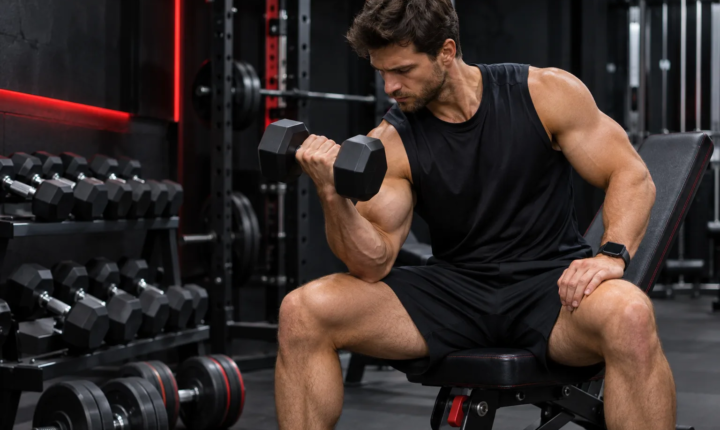
Hamstring training works best when it covers both hip extension and knee flexion. Want bigger hamstrings? Stop expecting squats, deadlifts, and leg curls to do the same job. The most useful starting point is to train the hamstrings through two different jobs: helping extend the hip and bending the knee. That distinction is worth more than a dozen fancy exercise variations. A Romanian deadlift or another controlled hip hinge gives you one kind of hard work; a leg curl gives you another. Put both in your program, progress them patiently, and you have a much stronger plan than doing extra squats and hoping the back of your thighs catches up.
Why hamstring training needs two movement patterns
Most of the hamstring muscles cross both the hip and knee. They help pull your thigh backward at the hip and bend your leg at the knee. The short head of the biceps femoris crosses the knee only. This matters because an exercise that challenges one joint does not necessarily load every hamstring region equally.
A hip hinge such as a Romanian deadlift lengthens the hamstrings as the hips move backward, then asks them to help extend the hips on the way up. The glutes and spinal erectors also contribute; a hinge is not an isolation exercise. A leg curl makes them produce knee flexion against resistance. These demands overlap in the muscles involved, but the joint action, muscle lengths and fatigue costs differ.
That is why pairing a hinge with a curl is more defensible than assuming one movement covers everything. It does not mean every region must be isolated or that two exercises are scientifically guaranteed to be optimal; it means you have a practical way to avoid a common blind spot.
Squats, lunges and leg presses are excellent exercises, but do not count on them to provide all your direct hamstring training. Because the hip and knee move together during many squat patterns, the hamstrings' length and contribution are not the same as in a hinge or curl. If your leg routine contains only squats and leg presses, the simplest improvement may be adding a hinge and a curl rather than another squat variation.
The hinge: make your hamstrings do the work
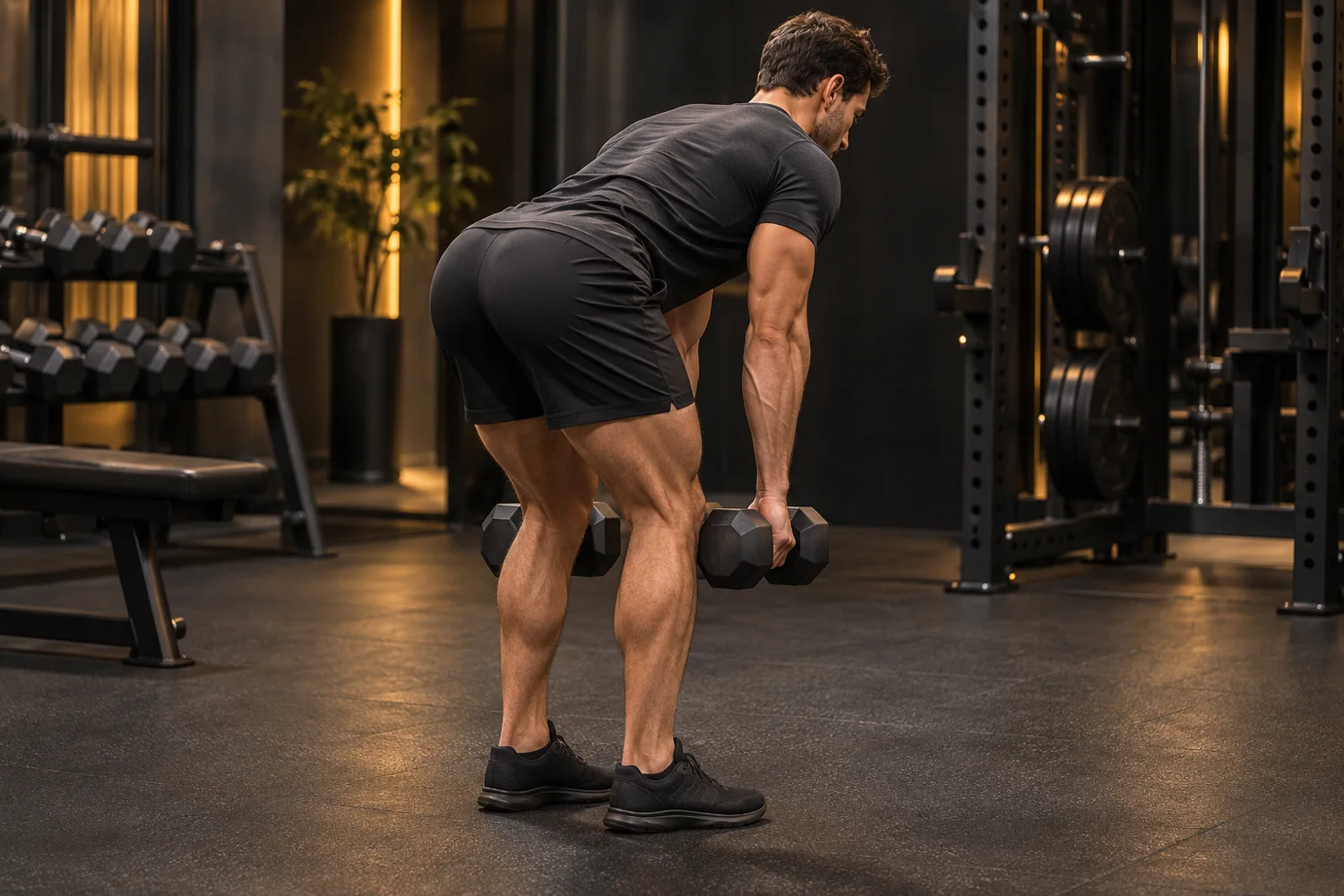
Start with the Romanian deadlift (RDL). Stand with the bar or dumbbells close to your thighs, brace your trunk, unlock your knees slightly, and push your hips backward while keeping the load near your legs. The bar should travel close to the body rather than drifting forward and making the lift harder to control. Keep your torso controlled and the weight close. Descend until you reach the deepest position you can control without rounding your back to chase a few more inches. Then drive your hips forward to stand tall.
Think “hips back,” not “bend down.” Make the hamstrings control the descent instead of chasing the floor with the weight. Your knees can bend modestly, but turning the movement into a squat changes the emphasis. You should feel substantial tension along the back of your thighs; you do not need to force an extreme stretch or touch the floor. A lifter with long legs, limited hip motion, or a different build may stop higher than someone else and still get an excellent set.
Use a load that allows repeatable technique. Two or three challenging sets of roughly 6–10 controlled reps are a reasonable starting point. These are practical programming choices, not a magic hypertrophy range. If your grip gives out before the hamstrings are challenged, straps can be useful. If your lower back is the limiting factor, first check the load, hinge pattern and fatigue; a stable machine or cable hip-extension alternative may be a better fit for that session.
The bottom position is not a contest. If your back position falls apart just to gain another inch, that inch did not make the set better. Depth matters only while the target muscles remain under controlled tension and your position stays stable. Slow down the lowering phase enough to own it; pause briefly if that helps prevent bouncing.
The curl: train knee flexion directly
A seated or lying leg curl lets you challenge the hamstrings without asking your spinal erectors and grip to support a heavy hinge. Set the machine so its pivot lines up reasonably with your knee and the pad sits comfortably near your lower leg. Keep your hips against the support, bend the knees through a controlled range, and return the weight without letting it slam.
If both machines are available and fit you well, start with the seated leg curl. Flexing the hips places the hamstrings that cross both joints at a longer starting length than in a prone curl. In a 12-week comparison, seated curls produced more growth in the two-joint hamstring muscles than prone curls, while both trained groups improved; the short head of the biceps femoris did not show the same advantage.
That gives the seated version a reasonable edge when the machines are equally comfortable and available. It does not establish that seated curls always win for every lifter, or that a lying curl is wasted work. The practical decision is simple: favor the seated machine when all else is equal, but use the version you can perform and progress consistently.
Choose the version you can set up comfortably and progress. Two or three challenging sets of about 8–15 reps work well as a starting example. A curl can be pushed closer to muscular failure than a technically demanding hinge because balance and spinal positioning are less likely to become the limiting factors. Still, keep your hips planted and your repetitions honest. If the stack flies upward while your pelvis lifts, you are moving weight rather than reliably training the intended movement.
What about Nordic curls? They are demanding knee-flexion work, especially during the lowering phase, and can be useful. But a full Nordic curl is not a beginner requirement. Assisted Nordics or machine curls make it easier to select an appropriate difficulty and accumulate controlled repetitions. A movement does not earn its place because it looks brutal. It earns its place because you can load it, control it, and improve at it.
How much hamstring training is enough?
There is no universal weekly set number that guarantees growth. Your starting point depends on your existing leg training, recovery, experience and how hard the sets actually are. A sensible starting trial for a recreational lifter is roughly six to eight direct challenging hamstring sets across the week, split between hinges and curls. This is a programming example, not a proven minimum effective dose, and it may need to be lower if your other training already creates substantial posterior-chain fatigue.
Treat that number as a starting experiment. Your training log and recovery will tell you whether it deserves to change. See our guide to sets per muscle per week for ways to assess your workload. A hard RDL set also taxes your back, grip and general recovery in ways that a machine curl usually does not.
Here is one example for someone training legs twice a week:
- Session A: Romanian deadlift, 3 sets of 6–10; seated leg curl, 2 sets of 10–15.
- Session B: seated leg curl, 2 sets of 8–12; Romanian deadlift, 1–2 sets of 8–10 if technique and recovery remain strong.
That is eight or nine direct sets depending on the second hinge dose—slightly above the six-to-eight-set starting trial, so choose the single set in Session B if you want to stay at eight. For a lower-fatigue six-set version, do two RDL sets and one curl set on Session A, then one RDL set and two curl sets on Session B.
If you are already deadlifting hard, squatting heavily, or playing a sprint-heavy sport, begin with less. If you are new to training, even one or two sets of each pattern in a week may be plenty while you learn the movements. The purpose of the example is to show the balance, not to prescribe an exact volume to everyone.
Another workable approach is to hinge on one lower-body day and curl on the other. That is especially useful when heavy hinging makes the rest of your session suffer. If you train legs only once weekly, both patterns can fit in that session; start with the movement you most need to improve, then use the other at a load you can still control. Training frequency is a way to distribute quality work; it is not a substitute for adequate effort and progression.
Train hard. Keep the reps honest.
For most productive sets, finish with roughly one to three repetitions left before you would fail with good form. This is called repetitions in reserve (RIR). It is an estimate, and it gets better with practice. On an RDL, stop before your position deteriorates even if your hamstrings could theoretically complete another rep. On a stable curl machine, you can occasionally work very close to failure while keeping the movement controlled.
Rest long enough that the next set is limited primarily by the target muscles rather than your breathing. Two or three minutes is a useful starting point for heavy hinges; curls may need somewhat less or a similar amount if you are training hard. If your reps collapse because you rushed, take longer. If you are ready sooner and performance holds, you need not stare at a stopwatch.
Make progress you can actually measure
Pick a rep range and record load, repetitions and how hard the set felt. Suppose your RDL target is 3 sets of 6–10. You perform 8, 8 and 7 clean reps with the same load. Over several sessions, aim to add a rep while keeping the same depth and control. Once you can do 10, 10 and 10 with solid technique, increase the load modestly and build again.
Use the same idea for leg curls. Machine stacks are not perfectly standardized, so compare performance on the same machine with the same settings. An extra rep achieved by lifting your hips or shortening the range is not the same progress as an extra clean rep.
Not every workout needs a personal record. A poor night of sleep, a hard squat workout, or lingering soreness can temporarily reduce performance. Look for a trend across several weeks. If strength and reps rise while technique remains consistent, your training is moving in a useful direction. Visible muscle growth takes longer and is harder to measure; performance is a practical leading indicator, not a guarantee.
When your hamstring training needs adjusting
If your lower back always gives out first on hinges, reduce the load and improve the setup. You might move the hinge earlier in the workout, choose dumbbells, or replace one hinge exposure with a supported option. A wrecked lower back is not a trophy for successful hamstring training.
If curls cause knee discomfort, check the machine alignment, range and load. Try another machine or a pain-free variation rather than forcing the same setup. Sharp pain or a suspected injury is not something to train through.
If you are so sore that the next leg session suffers, reduce the amount of unfamiliar eccentric work, especially after a long break. Build volume gradually. Severe soreness is not the goal; repeatable training is. Use the guide to changing exercises when a replacement solves a specific training problem.
If you have made no progress for several weeks, inspect the basics before adding exercises. Compare the same lift, range of motion, machine settings and effort across sessions; otherwise your log can hide progress or invent it. If your sets are easy and recovery is good, add one set to the lagging pattern and reassess over the next few weeks. If performance is dropping, soreness lingers and other leg lifts are suffering, reduce fatigue before increasing volume. Eating enough to support your goal also matters. More work is useful only when it solves the actual problem.
Build the plan. Then earn the progression.
Keep one hip hinge and one knee-flexion exercise in your program. Start with enough sets to practice and recover, train them hard with controlled form, and record your performance. Add volume or variety only when the evidence from your own training points to a need. The work is straightforward. The discipline is doing it consistently, with enough effort to grow and enough control to repeat it.
Research behind the recommendations
Maeo et al., Medicine & Science in Sports & Exercise (2021), seated versus prone leg-curl training: read the seated-versus-prone leg-curl study
Rosa et al., Strength & Conditioning Journal (2023), systematic review of single- versus multijoint training and muscle hypertrophy: read the systematic review and meta-analysis
Individual distribution of muscle hypertrophy among hamstring muscle heads (2024): read the hamstring hypertrophy study
THE COMPLETE GET MASSIVE MUSCLES SYSTEM
Turn the article into a training decision you can actually run.
The book teaches the method. The app carries the work into the gym and turns training history into useful feedback. The workbook structures the plan, review, and diagnosis.