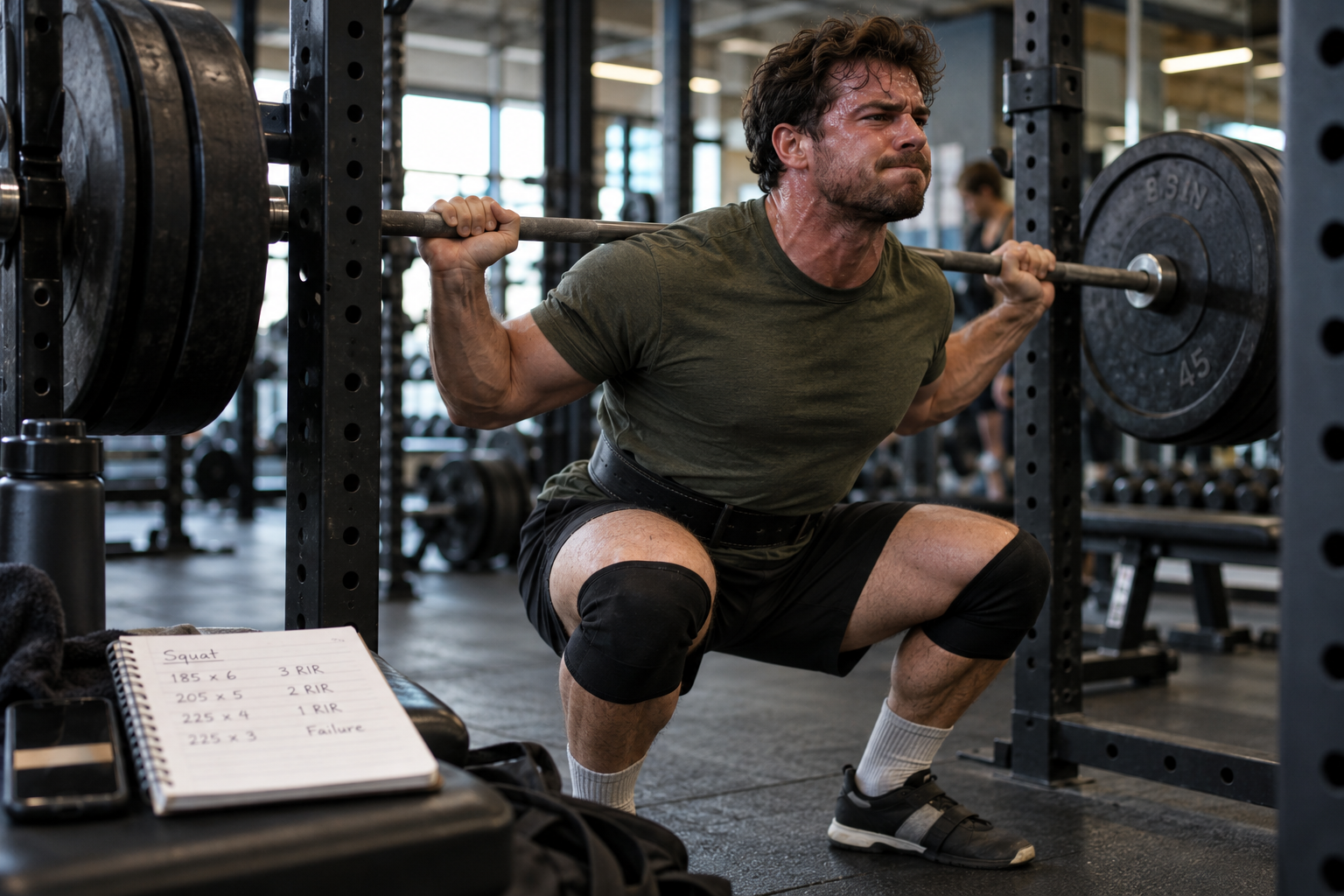
The classic “8–12 reps builds muscle” rule is useful shorthand, not a law. Muscle can grow across a much wider range of repetitions when the set is hard enough. That does not make rep selection meaningless. It means the real job is choosing a range that lets you attack the target muscle, keep the movement honest, recover, and progress without wasting effort on problems that have nothing to do with growth.
For a large share of hypertrophy work, moderate reps remain the workhorse. Roughly 6–15 reps covers a lot of productive training because the load is substantial without turning every set into a maximal-strength test, and the set usually ends before breathing, burning, grip, or concentration becomes the main battle. But useful muscle-building work extends both below and above that range.

The muscle does not count reps
Your muscles do not know whether the dumbbell stopped moving on rep 6, 10, or 18. Research comparing lower- and higher-load resistance training repeatedly finds that similar hypertrophy can occur across substantially different loading zones when the work is sufficiently demanding. Heavier loading has a clearer advantage for improving one-repetition-max strength, but muscle growth is much less loyal to one narrow rep bracket.
That finding gets abused. “A wide range works” does not mean every range is equally good for every exercise. A hard set of 25 leg extensions and a hard set of 25 barbell squats may both hammer the quadriceps, but the price is different. On the squat, breathing, bracing, lower-back fatigue, balance, and concentration can become the limiting factors before the quads get the clean work you wanted. On a stable machine or isolation movement, higher reps are often easier to push hard because the rest of the body is less likely to hijack the set.
That distinction matters far more than arguing over whether 10 reps has some magical advantage over 12.
Why moderate reps keep winning
Moderate-rep training survives every fitness trend because it solves several problems at once. The weight is heavy enough that you do not need an endless set to make the target muscle work. It is light enough that technique can usually stay stable for multiple productive repetitions. You also get enough reps to settle into the movement, control the lowering phase, and tell whether the target muscle is actually doing the job.
Take a dumbbell press. An 8–12 target lets you move serious weight while still accumulating enough repetitions to establish a strong, repeatable groove. If you can press the same dumbbells for 8 reps today and build that to 12 over time with comparable technique and effort, you have a clean progression path. You are building performance instead of turning every workout into a test day.
Now look at a cable curl, lateral raise, leg extension, or machine fly. There is usually little reason to force those movements into 5-rep sets. They often become more useful in the 10–20 range, where the target muscle can work brutally hard with less absolute load and less temptation to turn the movement into a whole-body heave.
Heavy compounds can push the other direction. Twenty Romanian deadlifts may be possible, but grip, breathing, spinal-erector fatigue, and concentration can become major constraints. A lower rep target may let you load the hamstrings hard while keeping every repetition recognizable. The rep range should serve the exercise. The exercise does not owe allegiance to a rep chart.
Heavy reps build muscle, but they charge a price
Low-rep training can absolutely contribute to muscle growth. A challenging set of 4–6 controlled reps places substantial tension on the working muscles. The tradeoff is practical efficiency. Heavy sets demand more from setup, technique, joints, and concentration, and each set gives you fewer repetitions of useful work. Trying to build an entire hypertrophy program from very low reps can mean more sets, more setup, and more time spent handling heavy loads.
That does not make heavy work bad. It makes it a tool with a cost. Use it when strength matters alongside size, when the exercise naturally suits heavier loading, or when you simply perform better and stay more focused with lower reps. Back away from it when chasing load starts shortening the range of motion, destabilizing technique, turning every session into a grind, or repeatedly aggravating a joint.
Strength and hypertrophy overlap, but they are not the same target. Heavy loading is especially useful for practicing the skill of producing force against heavy resistance. That helps explain why research generally favors heavier training for one-repetition-max strength even when muscle growth is similar across different loading conditions.
High reps work too, if the muscle is still the limit
A set does not become “endurance only” because the counter passes 15 or 20. Higher-rep sets can build muscle. The problem is that they hurt, and discomfort can muddy your judgment. With very light loads, the set also has to become genuinely demanding. Stopping because you reached a neat round number does not automatically create a useful hypertrophy stimulus.
Exercise choice changes everything. Twenty hard leg extensions are straightforward: the machine stabilizes you and the quadriceps can remain the obvious limiting muscle. Twenty hard barbell rows are messier. Your lower back may fatigue, torso angle may rise, grip may weaken, and the last few reps may barely resemble the first few. At that point you are not proving that high reps are hardcore. You are changing the exercise inside the set.
That is why higher reps fit stable movements so well. Machines, cables, dumbbell isolation work, and many bodyweight movements can tolerate 12–20 or more reps without technique becoming the main problem. Large free-weight compounds are often easier to use productively at lower rep counts, where cardiovascular fatigue and technique drift have less time to take over.
Effort changes what the number means
A rep prescription without an effort standard is incomplete. Ten reps with a weight you could have lifted 20 times is not the same training demand as ten reps with a weight you could have lifted 11 or 12 times.
You do not need to take every set to absolute failure. You do need enough effort that your working sets are actually working sets. This matters even more as the load gets lighter. A high-rep set can feel miserable long before the target muscle reaches its limit, so you have to learn the difference between discomfort and muscular failure. If every light set ends the moment it burns, the theoretical hypertrophy potential of high-rep training does not matter much.
This is why copying somebody else’s “three sets of 12” is almost useless without knowing how those sets were performed. One lifter can finish 12 reps with six clean reps still available. Another may have one left. Same number. Completely different demand.
Choose the range for the movement
Stop forcing every exercise into one hypertrophy box. Start with a range that fits the movement, then earn the right to keep it by seeing how it performs in actual training.
Heavy compounds such as squats, presses, rows, and Romanian deadlifts often work well around 5–10 or 6–12 reps. Those are starting points, not scientific borders. The goal is enough load to challenge the target muscles while keeping the set short enough that breathing, bracing, grip, or technique does not become the real exercise.
Stable machine compounds such as chest presses, hack squats, leg presses, and machine rows often tolerate somewhat higher reps. Something like 8–15 is a useful default because the machine removes part of the stability demand and gives you more freedom to drive the target muscles hard.
Isolation movements such as curls, pressdowns, lateral raises, flyes, leg extensions, and leg curls often fit naturally around 10–20 reps, and some lifters prefer them even higher. A lateral raise does not become more serious because you can grind out five ugly reps with a dumbbell too heavy to control.
None of those ranges is sacred. If your knees, lungs, and technique handle 15-rep squats well, there is no reason to abandon them because a chart ends at 10. If cable curls feel strongest and cleanest at eight, use eight. The range is doing its job when the target muscle is challenged, technique stays honest, effort can be judged, and progression is measurable.
Make the rep range earn its place
Pick a range, then progress inside it. Suppose your machine chest press target is 8–12 reps. You begin with a load that gives you 9, 9, and 8 hard, controlled reps. Over the next sessions, fight for clean repetitions while keeping the setup, range of motion, and effort standard reasonably consistent. Eventually you reach 12 across the working sets. Add a small amount of weight, let the reps fall back, and build again.
That simple process gives the range a purpose. It creates a performance target you can measure instead of a number you merely repeat.
The exact progression system does not need to be identical on every exercise. A lateral raise may need a wider rep range because moving from one dumbbell to the next can be a large percentage jump. A barbell press may use a narrower range because five-pound increases are easy to measure. The principle stays the same: establish a repeatable target, improve it, then increase the demand.
That is stronger programming than constantly changing rep schemes because you are afraid the muscle has somehow “figured out” 10 reps.
When should you change rep ranges?
Change a productive range when it stops fitting the exercise or your goal, not because your muscles supposedly adapted to a number.
Move somewhat lower when you want more strength practice, when high reps make effort hard to judge, or when breathing and general fatigue repeatedly end the set before the target muscle. Move higher when heavy loading makes an isolation movement clumsy, when a stable exercise simply feels better with more repetitions, or when equipment jumps are too large for smooth progression. If a loading range repeatedly produces joint pain, do not worship the prescription. Change the load, technique, range, or exercise as appropriate rather than treating the number as sacred.
You can also use different ranges for the same muscle. A chest session might use a barbell or dumbbell press for 6–10 reps, a machine press for 8–15, and a cable fly for 12–20. That is not “muscle confusion.” It is just matching the loading range to the movement.
The rep-range rule that actually matters
There is no single best hypertrophy rep range. There is a broad field of useful loading, and your job is to choose the part of that field that makes each exercise productive.
Use moderate reps as the default because they are efficient, controllable, and easy to progress. Use heavier sets when strength and the exercise justify them. Use higher reps when stability, joint comfort, equipment, and exercise design make them useful. Then keep the sets hard enough to matter, keep the technique honest, and force performance upward over time.
Do not turn 8–12 into religion. The rep counter is not the goal. More muscle is.
Key Takeaways
Muscle growth can occur across a wide range of loads and repetitions when training is sufficiently challenging.
Moderate reps, roughly 6–15, are a strong practical default because they balance load, control, fatigue, and progression.
Heavier training has a clearer advantage for maximal-strength development than for hypertrophy itself.
Higher reps often fit stable machine and isolation exercises especially well, while large free-weight compounds may be more practical at lower rep counts.
Choose rep ranges by exercise, train with meaningful effort, and progress performance instead of chasing a mythical perfect number.
Sources
American College of Sports Medicine. Resistance Training Prescription for Muscle Function, Hypertrophy, and Physical Performance in Healthy Adults: An Overview of Reviews. 2026. Research source
Schoenfeld BJ, Grgic J, Ogborn D, Krieger JW. Strength and Hypertrophy Adaptations Between Low- vs. High-Load Resistance Training: A Systematic Review and Meta-analysis. Journal of Strength and Conditioning Research. 2017;31(12):3508–3523. Research source
Refalo MC, Hamilton DL, Paval DR, Gallagher IJ, Feros SA, Fyfe JJ. Influence of resistance training load on measures of skeletal muscle hypertrophy and improvements in maximal strength and neuromuscular task performance: a systematic review and meta-analysis. Journal of Sports Sciences. 2021;39(15):1723–1745. Research source
Carvalho L, Moriggi Junior R, Barreira J, Schoenfeld BJ, Orazem J, Barroso R. Muscle hypertrophy and strength gains after resistance training with different volume-matched loads: a systematic review and meta-analysis. Applied Physiology, Nutrition, and Metabolism. 2022;47(4):357–368. Research source
Use a clear progression method to compare useful training work across sessions.
For related guidance, see how close to failure to train when deciding how demanding working sets should be.
THE COMPLETE GET MASSIVE MUSCLES SYSTEM
Turn the article into a training decision you can actually run.
The book teaches the method. The app carries the work into the gym and turns training history into useful feedback. The workbook structures the plan, review, and diagnosis.